
WHAT IS AN INTERNAL WORLD?
The "internal world" is a term used to describe the mental landscape where alters of a dissociative system live, communicate, or simply exist. While some survivors' internal spaces came to be organically as children - and remain fixed until today - others only discovered their utilitarian or emotionally rich value as adults trying to heal. This impressively beautiful achievement of the human mind isn't given nearly enough recognition or support, though. So, whether you’re brand new to this work, are looking to do some ‘remodeling,’ or realize you missed some vital steps along the way, there are countless ways to cultivate an internal world that's ideal for you! ALL of you!
While no system requires an internal world, and conditions like aphantasia may pose added barriers, there can be real advantages to having a space inside the mind to interact and collaborate with one another. It can also be one of the most exciting, creative, and FUN aspects of having a dissociative system! Hopefully, this guide will tackle some of your questions, provide some visual inspiration, and stir any internal chatter you've been lacking.
Feel free to bookmark or share this resource with others who may benefit, including mental health professionals. Internal spaces are given shockingly little attention or discussion clinically, even amongst trauma specialists. Given how integral they can be for the daily function, emotional bonding, and overall safety of a dissociative system, survivors deserve everything we have to offer.
Happy building!
Note: If you’d like some visual inspiration and a more interactive way of learning,
use the slideshow below. If you prefer text only, scroll to the list below.
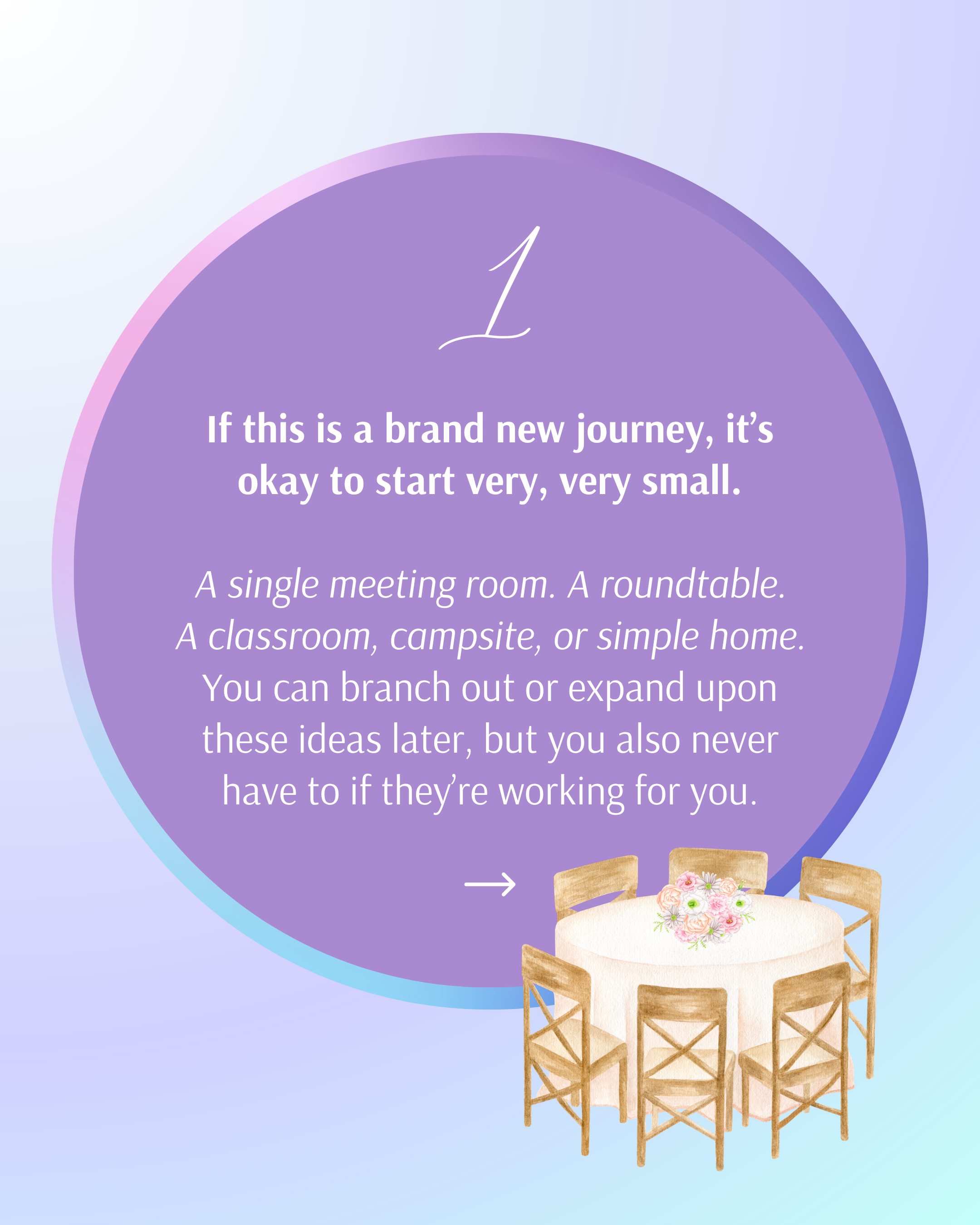
If this is a brand new journey, it’s okay to start very, very small.
A single meeting room. A roundtable. A classroom, campsite, or simple home. You can branch out or expand upon these ideas later, but you also never have to if they’re working for you.
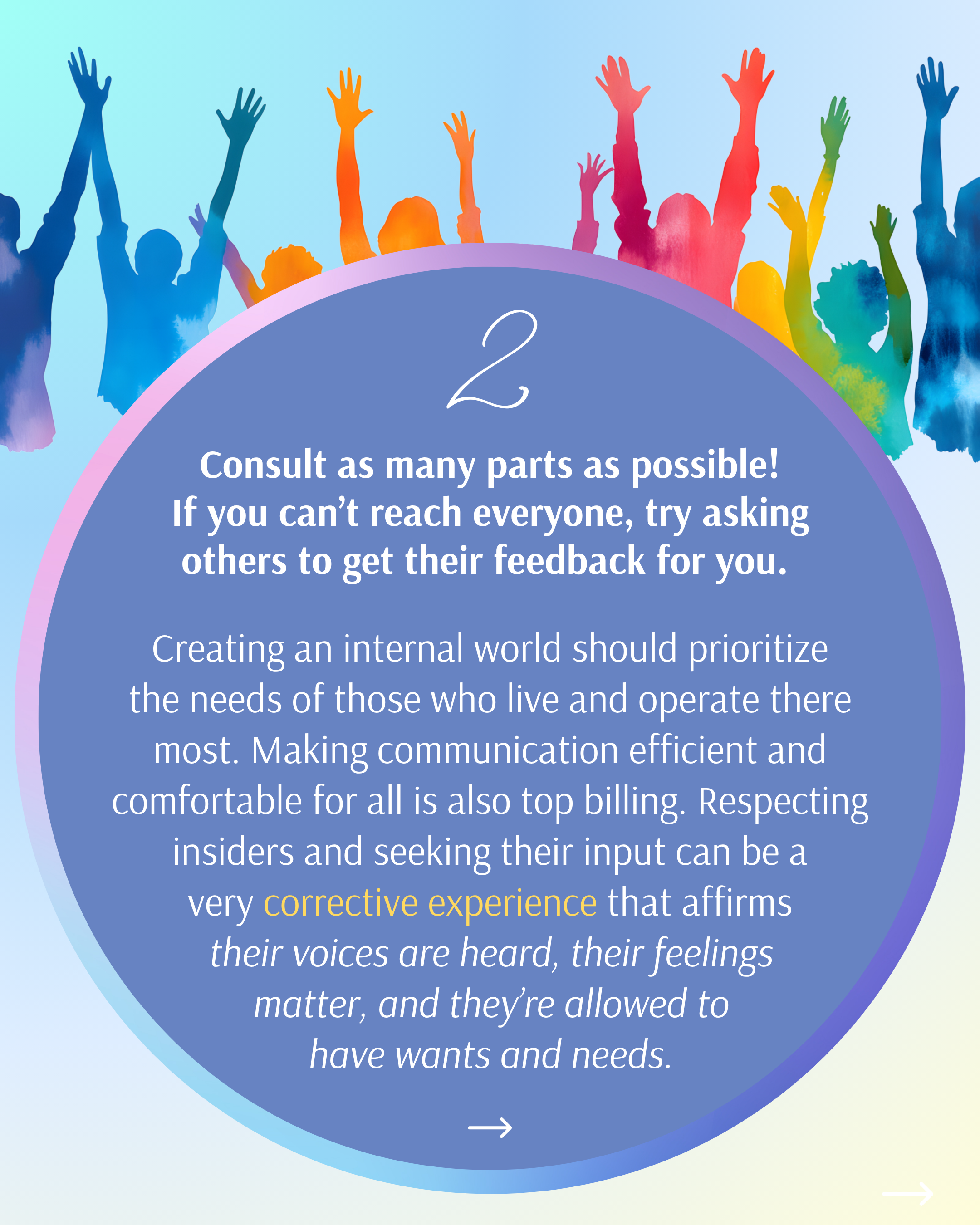
Consult as many parts as possible! If you can’t reach everyone, try asking others to get their feedback for you.
Creating an internal world should prioritize the needs of those who live and operate there most. Making communication efficient and comfortable for all is also top billing. Respecting insiders and seeking their input can be a very corrective experience that affirms their voices are heard, their feelings matter, and they’re allowed to have wants and needs.
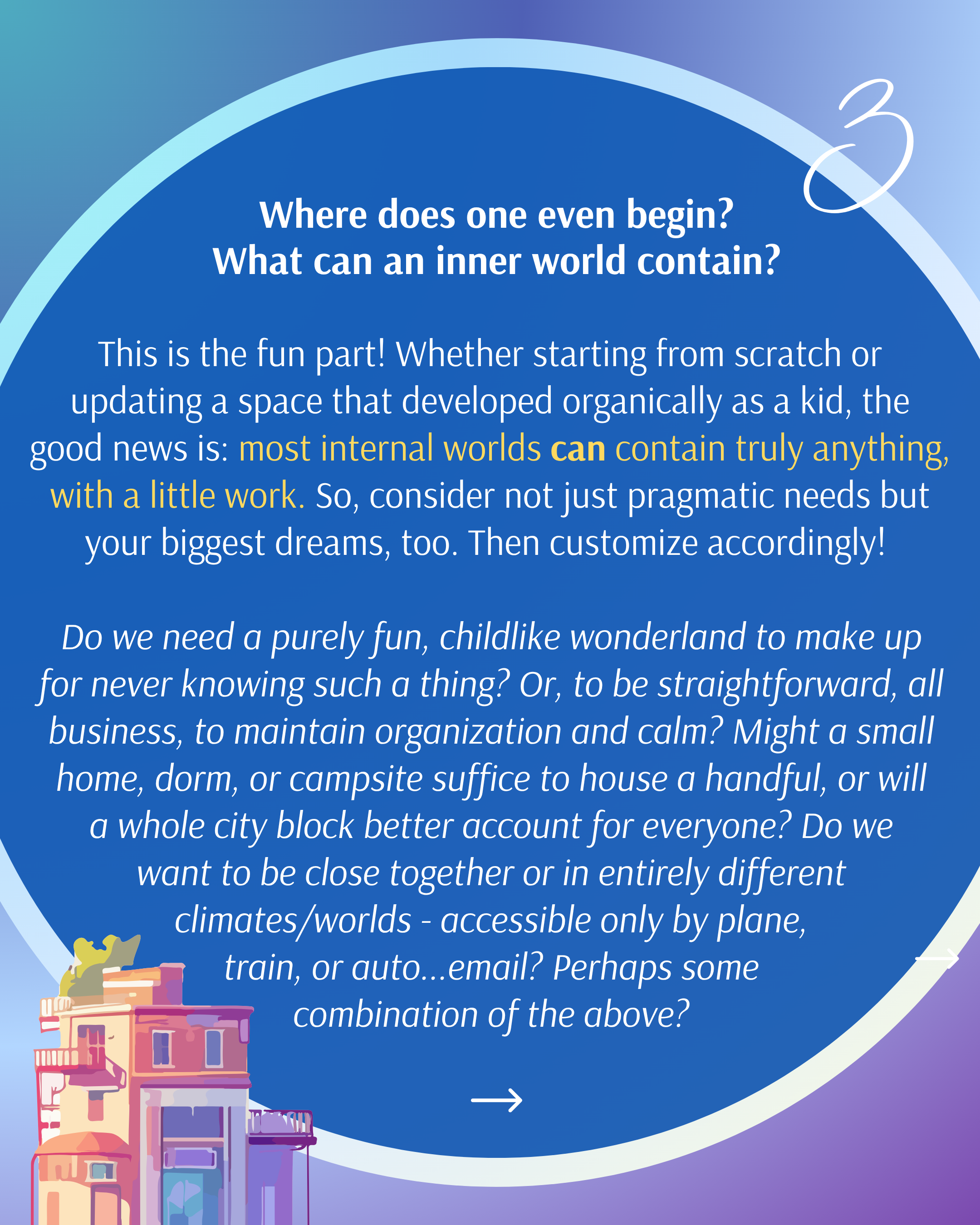
Where does one even begin? What can an inner world contain?
This is the fun part! Whether starting from scratch or updating a space that developed organically as a kid, the good news is: most internal worlds can contain truly anything, with a little work. So, consider not just pragmatic needs but your biggest dreams, too. Then customize accordingly!
Do we need a purely fun, childlike wonderland to make up for never knowing such a thing? Or, to be straightforward, all business, to maintain organization and calm? Might a small home, dorm, or campsite suffice to house a handful, or will a whole city block better account for everyone? Do we want to be close together or in entirely different climates/worlds - accessible only by plane, train, or auto...email? Perhaps some combination of the above?
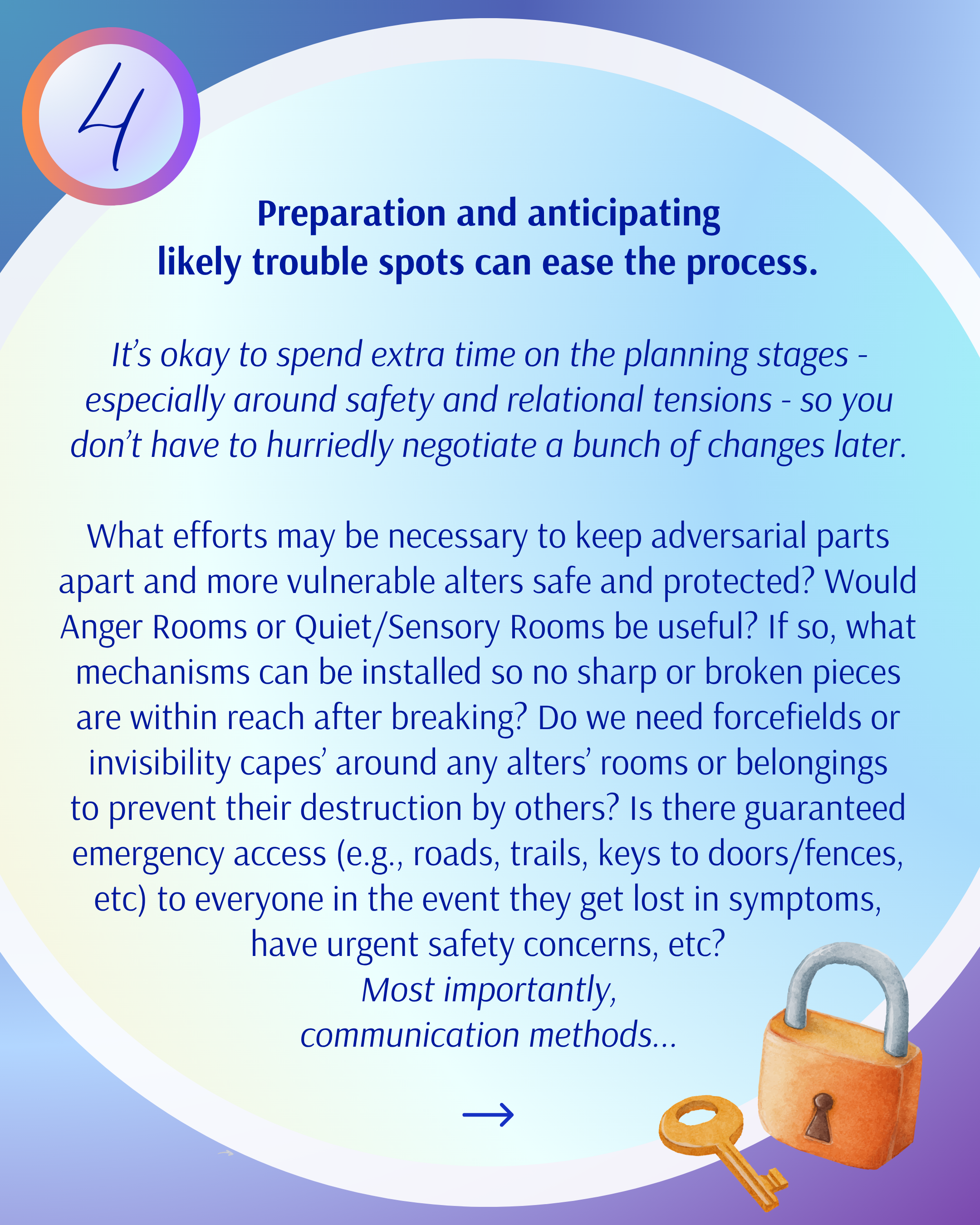
Preparation and anticipating likely trouble spots can ease the process.
It’s okay to spend extra time on the planning stages - especially around safety and relational tensions - so you don’t have to hurriedly negotiate a bunch of changes later.
What efforts may be necessary to keep adversarial parts apart and more vulnerable alters safe and protected? Would Anger Rooms or Quiet/Sensory Rooms be useful? If so, what mechanisms can be installed so no sharp or broken pieces are within reach after breaking? Do we need forcefields or invisibility capes around any alters’ rooms or belongings to prevent their destruction by others? Is there guaranteed emergency access (e.g., roads, trails, keys to doors/fences, etc) to everyone in the event they get lost in symptoms, have urgent safety concerns, etc?
Most importantly, communication methods...
Communication is everything! Making it a built-in feature instead of an afterthought can benefit you for years.
Not only do we want parts able to connect internally with ease but also be able to quickly exchange messages with whomever is up front. A little creativity can set you up for life!
Potential options: intercom systems, cell phones, or landlines in each room; inner world versions of email, texting, or group chats; message pads, dry-erase boards, or dropboxes kept in common areas for note exchange; or, for parts hardest to reach, carrier pigeons, snail mail, sky-writers, blimps, marquis, etc! Rules around ringers, notifications, and time availability are wise to install early.
Seeking inspiration together can boost internal communication and get imaginations running wild!
Invite parts to join you as you browse creative materials.
Websites like deviantArt, Pinterest, and flickr hold a wealth of non-traditional living spaces – fantasy, high-tech, medieval, otherworldly, you name it. Home and garden, architecture, and landscaping magazines (that local doctors/dentists/salons can be eager to offload) often have noth practical and aspirational ideas. Googling for kid/teen bedrooms, treehouses, or tiny homes specifically can help young (or more ‘sheltered’) parts imagine their options - especially if their limited exposure to the world is making that tough.Save your faves and pull out anything you “just feel called to”. It may be someone’s quiet attempt to let you know they’re there.
Throw realism out the window! You don’t have to worry about money, space, or even gravity.
Internal world rules don’t have to respect the laws of physics, reality, or social norms.
Want to change your wallpaper or bedspread daily? Cool! Want to teleport, ride on clouds, or send notes via pink sparkly orb? Make it happen! Want a floorplan that could never have functional plumbing in the real world? No prob. Who was keeping track anyway? Want a constant view of Jupiter, eco-friendly private jet at your fingertips, or the most teched-out teen bedroom within a realistic medieval castle? Rad, why not?!While not every dream or reality-bending ask will be doable - or make sense for every system - it never hurts to consider or try them out. You can always switch things back!
SAFETY IS PRIORITY ONE. Objects or areas that are unsafe should be excluded entirely or have strict rules attached to protect everyone.
While we recognize many safety rules do get broken, and internal destruction may still take place, making a collective effort to try ensuring all parts’ safety is an important precedent to set. Without providing an example list of common ‘wants’ (lest we accidentally give ideas), be prepared to set firm boundaries around any unsafe items, imagery, or places that may be suggested (or even successfully “snuck in”).
Don’t forget to consider things you DON’T want to be in the internal space.
As you’re gathering inside feedback, be sure to ask parts what they DON’T want, too. Consider what rules or guidelines each alter may wish to request NOT be allowed inside. This is mainly reserved for triggers and safety concerns. Examples may include: No mirrors, no [phobia item], no masks, no weapons (even decorative), no specific kids’ toy or game, no smoking or alcohol, no scales, no fire, no specific color/animal/flower/sports or team memorabilia/perfume/song, etc.
While some requests may be untenable (e.g., no food, no beds, etc), sharing still provides an opportunity to learn about each other and strategize ways around any things causing distress.
Don’t forget to include joyful, “just because” items!
While we can’t forget the essentials and need to prioritize daily functioning over form, it’s okay to have things you simply want. You are allowed to have nice things. ...whether to fulfill childhood dreams or those of very tired grown-ups.
Pets, pools, pianos; art supplies, twinkle lights, and video games; dance studios, ferris wheels, tree houses; rope swings, sports stadiums, or the dreamiest library you’ve ever seen! A lil whimsy can restore a world of withered hope.
You’re allowed to have FUN. It’s okay to enjoy this process! It doesn’t make you ‘fake,’ unserious, or any other shaming adjective.
Yes, this is a serious endeavor overall.
It involves a condition and parts of a system with complex, sensitive needs - most due to grave trauma. None of that becomes untrue by enjoying the creative fruits of your brilliant mind.There are so few joys in trauma/system work, why not let this be one of them? Give Little You the freedom they always deserved, and Current You some long overdue rest and reprieve.
But, how?! How do we actually create the space? Do I just picture it? How do I get there?
This can be the toughest part for some folks, while barely a question for others. However you experience this stage, you are NOT alone!
For some, it’s similar to developing Safe Place imagery, just using deeper concentration, the active involvement of as many system members as possible, and prioritizing permanence (versus a temporary retreat). Some make visual aids (drawings, collages, maps, floorplans), or write detailed descriptions followed by a slow, hyper-detailed, multi-sensory walkthrough with parts. They may visualize each item in its place, building and rebuilding the area until it’s just right.Many install a mental “entry point” to access the inner world (e.g., a large vault door, elevator, teleportation tube, gated fence, etc) – calling it to mind first, then transitioning inside. Others like to create a “green room” or sitting area just ‘behind the eyes’ that parts can either chill in before fronting, use to simply observe “real life,” or return to after being up front (to make the transition less abrupt or painful).
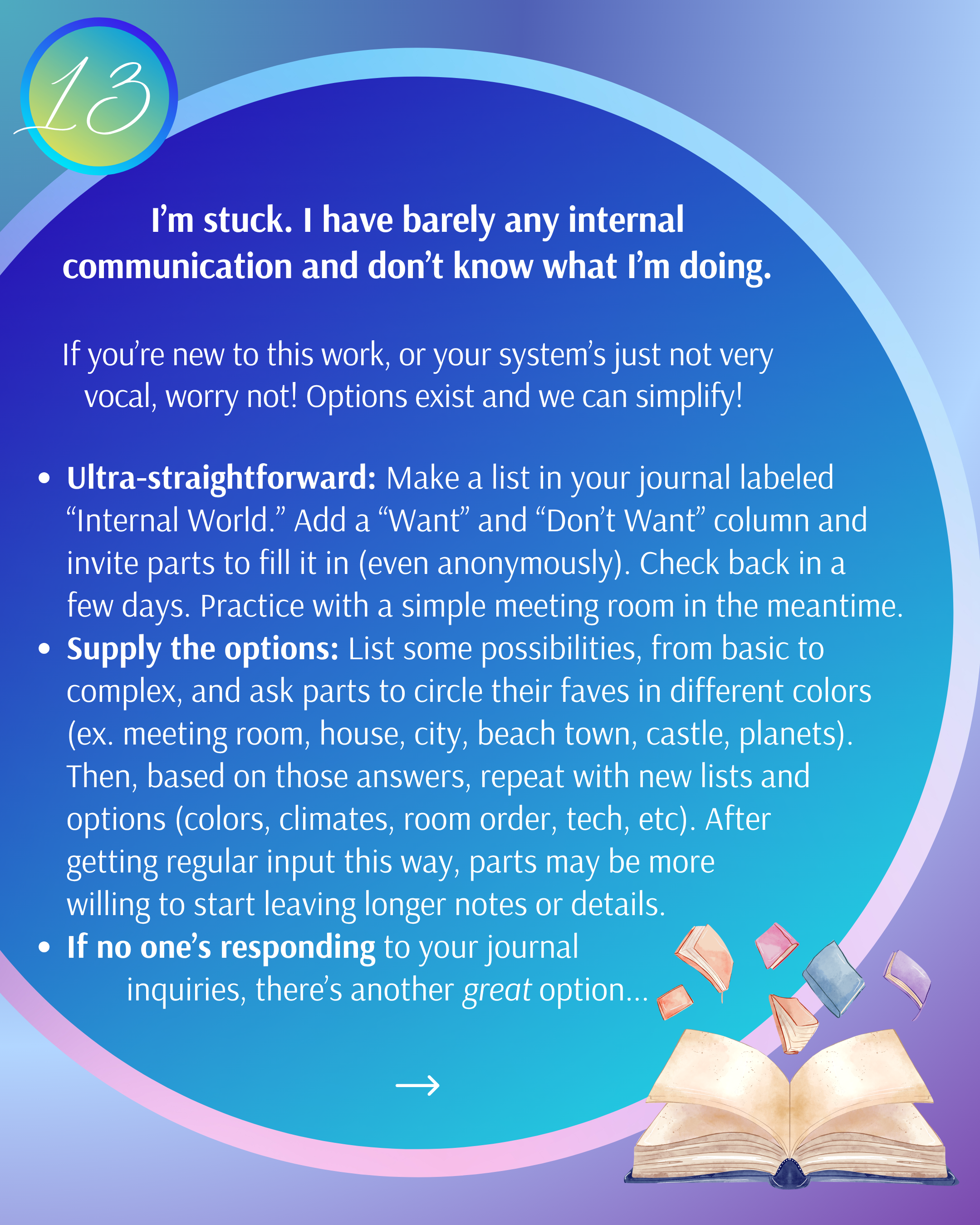
I’m stuck. I have barely any internal communication and don’t know what I’m doing.
If you’re new to this work, or your system’s just not very vocal, worry not! Options exist and we can simplify!
Ultra-straightforward: Make a list in your journal labeled “Internal World.” Add a “Want” and “Don’t Want” column and invite parts to fill it in (even anonymously). Check back in a few days. Practice with a simple meeting room in the meantime.
Supply the options: List some possibilities, from basic to complex, and ask parts to circle their faves in different colors (ex. meeting room, house, city, beach town, castle, planets). Then, based on those answers, repeat with new lists and options (colors, climates, room order, tech, etc). After getting regular input this way, parts may be more willing to start leaving longer notes or details.
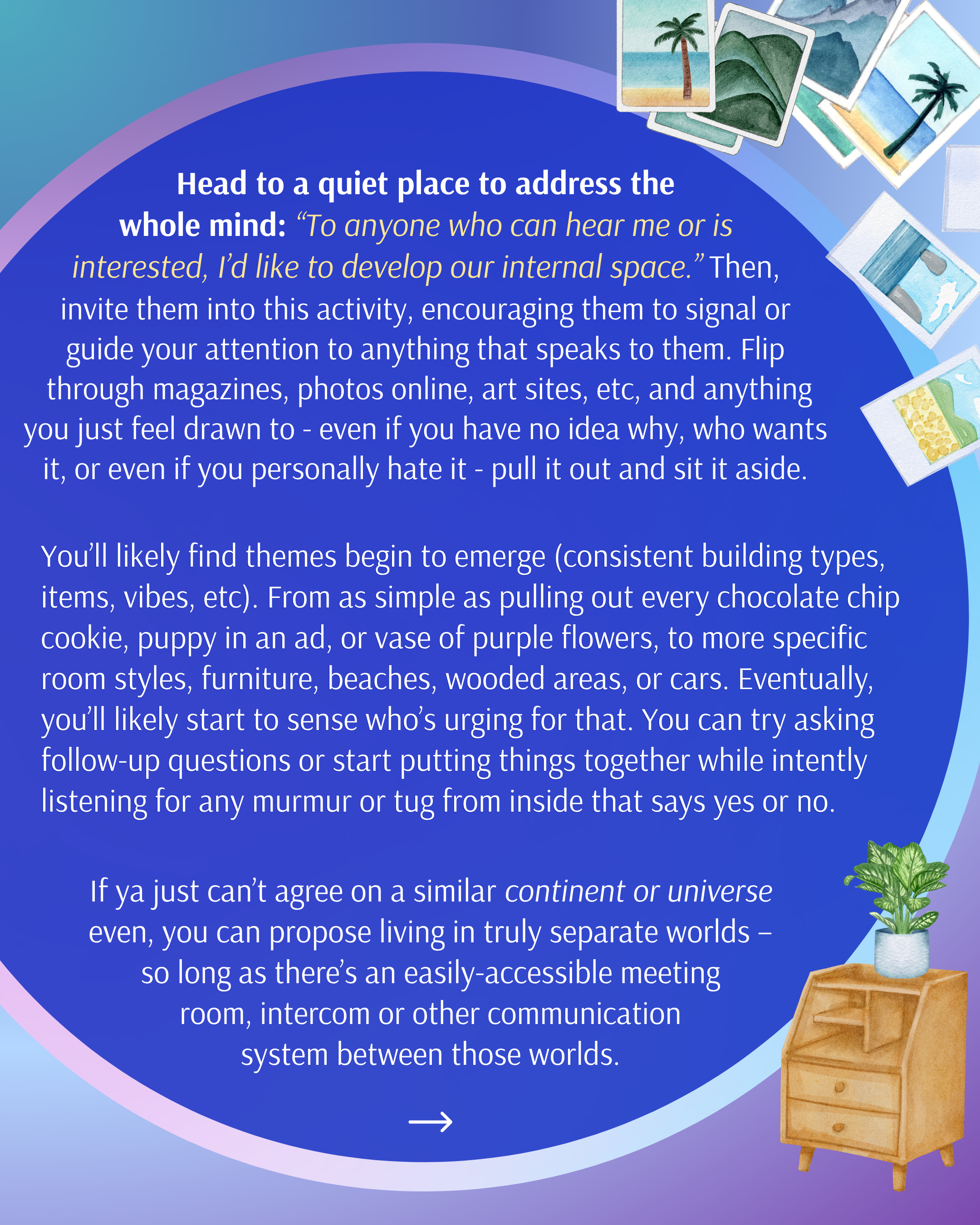
If no one’s responding to your journal inquiries: Head to a quiet place to address the whole mind: “To anyone who can hear me or is interested, I’d like to develop our internal space.” Then, invite them into this activity, encouraging them to signal or guide your attention to anything that speaks to them. Flip through magazines, photos online, art sites, etc, and anything you just feel drawn to - even if you have no idea why, who wants it, or even if you personally hate it - pull it out and sit it aside.
You’ll likely find themes begin to emerge (consistent building types, items, vibes, etc). From as simple as pulling out every chocolate chip cookie, puppy in an ad, or vase of purple flowers, to more specific room styles, furniture, beaches, wooded areas, or cars. Eventually, you’ll likely start to sense who’s urging for that. You can try asking follow-up questions or start putting things together while intently listening for any murmur or tug from inside that says yes or no.
If ya just can’t agree on a similar continent or universe even, you can propose living in truly separate worlds – so long as there’s an easily-accessible meeting room, intercom or other communication system between those worlds.
**Post note: To our survivors of organized abuse and/or those who’ve had their internal worlds made for them - we encourage you to tread lightly when trying to change the internal world. Go slowly and ask for internal input before making moves, as some modifications can have unintended consequences. There are ways to work through this, and we hope you have a supportive clinician to help you navigate this safely. Some systems will be able to modify most anything without issue, while others experience friction at every step. If this message doesn’t apply or makes no sense to you, don’t worry! Just skip it and move along :)
Remember: There is no one way, no “correct,” and no perfect way to have an internal world. It can be a project always in flux. Every system is unique and has their own set of explicit needs, abilities, and ways of functioning. Some will find their internal landscape feels more ‘fixed’ or ‘unmovable’, while others can change it at will. Some may struggle with it being regularly destroyed while others just might be unable to have one altogether (be it from disinterest, not finding it helpful, or it just not “sticking”). There is no one way to have a dissociative mind.
Troubleshooting with other systems may be extremely beneficial, but try not to compare too much. Every mind is unique and should aim for what’s most helpful to their survival, internal harmony, and happiness. What is something you wish you'd known or implemented sooner when it comes to internal worlds?

MORE POSTS YOU MAY FIND HELPFUL:
✧ Grounding 101: 101 Grounding Techniques
✧ Flashbacks 101: 4 Tools to Cope with Flashbacks
✧ Self-Care 101: 101 Self-Care Tools
✧ Distraction 101: 101 Distraction Tools
✧ Nighttime 101 and Nighttime 201: Sleep Strategies for Complex PTSD
✧ Color Breathing 101: How to Calm Overwhelming Emotions and Physical Pain
✧ Imagery 101: Healing Pool and Healing Light
✧ Modulation 101: Using Dials to Modulate Intrusive Mental Health Symptoms
✧ DID Myths: Dispelling Common Misconceptions about Dissociative Identity Disorder
✧ Managing Unmanaged Dissociation: 15-minute Checksheets
❖ Article Index ❖
FIND US ON SOCIAL MEDIA:
✦ Facebook: Beauty After Bruises // Therapy Box Project
✦ Instagram: Beauty After Bruises // Therapy Box Project
✦ Threads
✦ Twitter/X