In previous articles, we’ve talked a fair bit about flashbacks, particularly in the context of offering tools and strategies to manage them. We’ve also explored the more specific and unique phenomena of Emotional Flashbacks and Body Memories in social posts — all in the hopes of offering new ways to understand and work through them! What we haven’t done, though, is take a proper dive into the mechanism behind all flashbacks, solidifying the ways traumatic memory is stored differently in the mind than safe, mundane, unfractionated memory. To do this, we can look to something called The BASK Model of dissociation and memory.
When a traumatic event occurs, for many folks, strong dissociation steps in as a means of self-protection. It helps compartmentalize the experience, or cast some pieces of it far outside of conscious awareness where it cannot be reached. It would be too distressing to have it fresh on your mind, or even too easily-accessible, when you're trying to go to work or just make dinner. But, memories are made up of a vast, colorful array of mental, physical, emotional, and sensory experiences! Where do they all go if they’re pushed aside or separated from each other? And, what unintended consequences might that have? To begin understanding the answers to those questions, we can first simplify by considering each memory as made up of four main parts: Behavior, Affect, Sensory, and Knowledge (BASK).

Let’s break those down a little further!
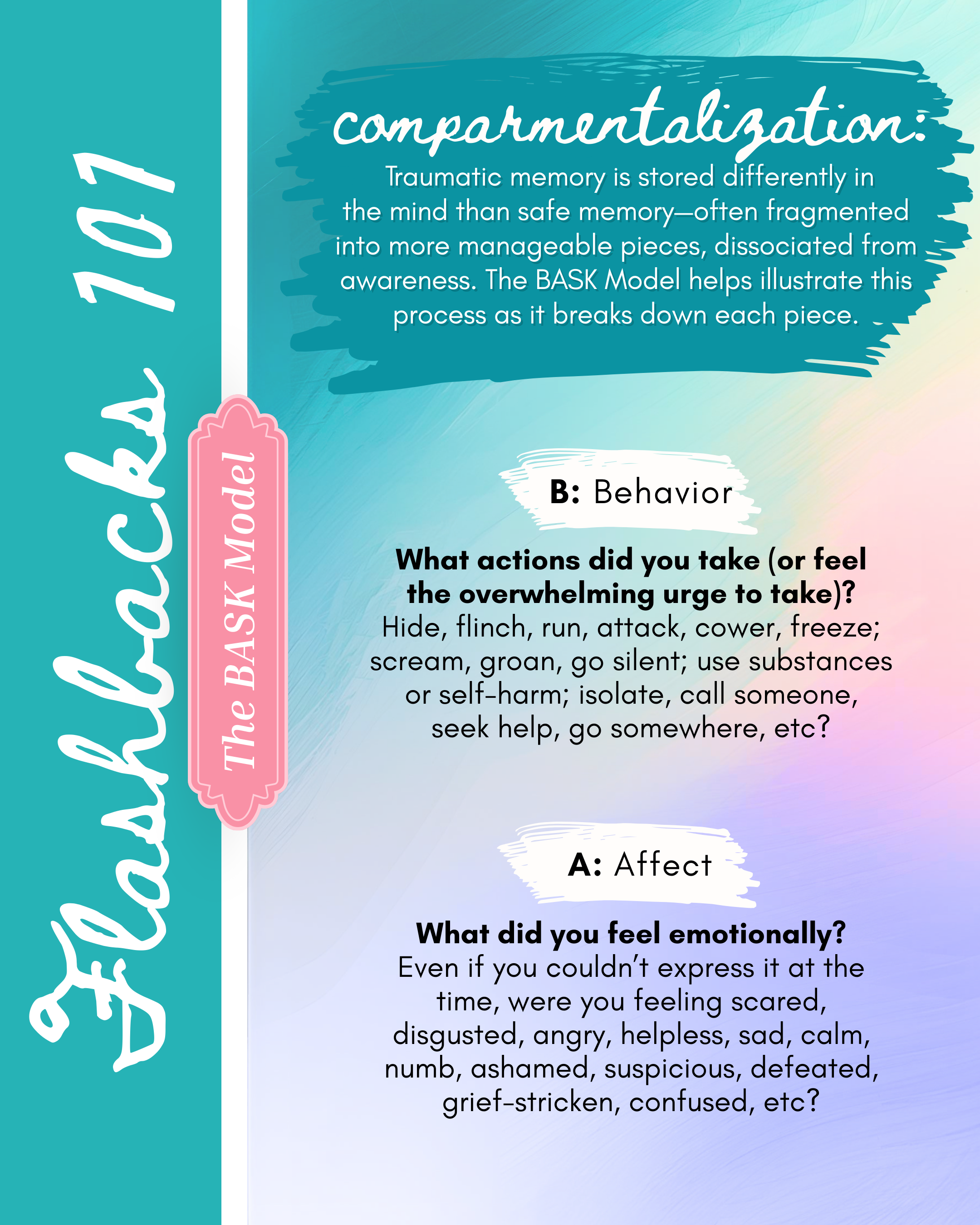
Behavior — What was the action in this memory? What did you physically do - or feel the overwhelming compulsion to do - with your body? Hide, flinch, run, attack, cower, freeze; scream, groan, go silent? Use substances, self-harm, or do some other self-destructive action (even unintentionally)? Isolate, call someone, seek help, go to a certain place, etc?
Affect — What were your emotions in this moment - even those stifled or shut-off in the moment? Were you sad, afraid, angry, worried, oddly calm? Disgusted, helpless, ashamed, defeated, conflicted, intimidated? Enraged, suspicious, or even entirely numb or apathetic? Try to discern those from what you feel about the trauma today. It maybe difficult as many unsafe situations don’t allow us to freely feel our authentic emotional reactions.
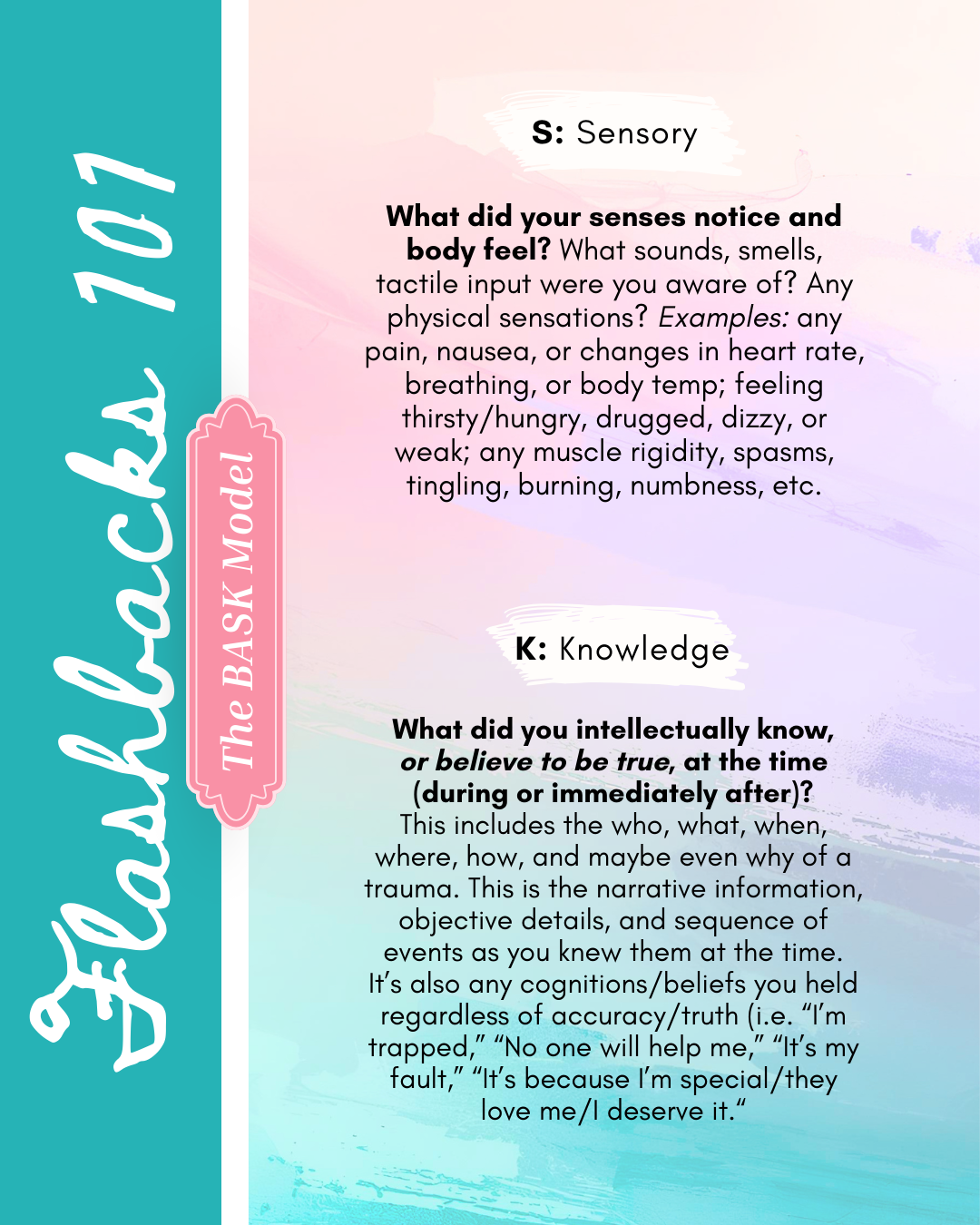
Sensory — Take in all the sensory details of a memory. hat were the sensations in your body? Were you smelling anything in particular? Hearing specific things? Keys, footsteps, loud bangs, painful silence, whispering, creaking in a floor or door, cars, extreme weather, music, etc? Did you have any tastes? External feelings against your skin? Now take stock of any physical body sensations at the time. Racing heart, physical pain, thirst, trouble breathing, chills, clenched jaw, dizziness, or numbness? Were you dizzy or feel off-balance/spinning, intoxicated, or exhaustion; did you have sweaty palms, nausea, muscle tension, an uptick in symptoms of a health condition, etc?
Knowledge — What were you intellectually aware of at the moment (the who, what, when, where, how)? This is a combination of explicit memory - the trauma narrative, objective information, sequence of events, etc, as well as any cognitions/beliefs you held at the time - regardless of their accuracy/validity (i.e. “I’m trapped,” “No one is coming,” “This will never end,” “This is normal/everyone goes through this”). What did you believe was happening or think to yourself as this moment was occurring - even if you later learned you were incorrect? (For example, “I knew I was going to die,” despite learning the person was actually unarmed, a safety feature kicked in, a storm changed direction, etc. Or, “I thought we were playing a silly innocent game and had fun,” despite learning as a adult that the activity was dangerous, perverse, malintentioned, or not age appropriate.)
Having all this information unified in one massive ball or terror and trauma can just be too oppressive and inescapable. So, during the mind’s unconscious process of putting thick dissociative barriers around this extremely sensitive material, some of the pieces can scatter apart into far corners of the mind. They may all be fully detached from one another or paired up in unique, and sometimes perplexing, combinations.
When we push anything out of our awareness long enough - like when we stuff our feelings, pretend something or someone doesn’t exist entirely, or have to traumatically dissociate an event away entirely - it is very likely to be intrusively thrust upon us against our will later. ...and typically when we're most vulnerable, least expect it, or will be most inconvenienced. We know that a defining trait of PTSD, and one of its criterion for diagnosis, is "re-experiencing". This increases in frequency and intrusive strength the longer we go pushing distressing material away. There are important lessons and safety information in there that our minds can get scared are being forgotten or missed. So, it tries to show us; only now it has to do so in fragments.
When we look to the BASK Model, and some of the unusual pairings that traumatic information can get separated into, you can easily understand how having them suddenly surface and come alive in your body, without all the other important contextual clues, could be deeply disorienting. It is understandably confusing, but also sometimes quite scary, too. It’s also often easier to explain the experience away by a hundred other things. Health, work stress, a bad night’s rest, something we saw on TV, ‘coming down with something’ – you name it!
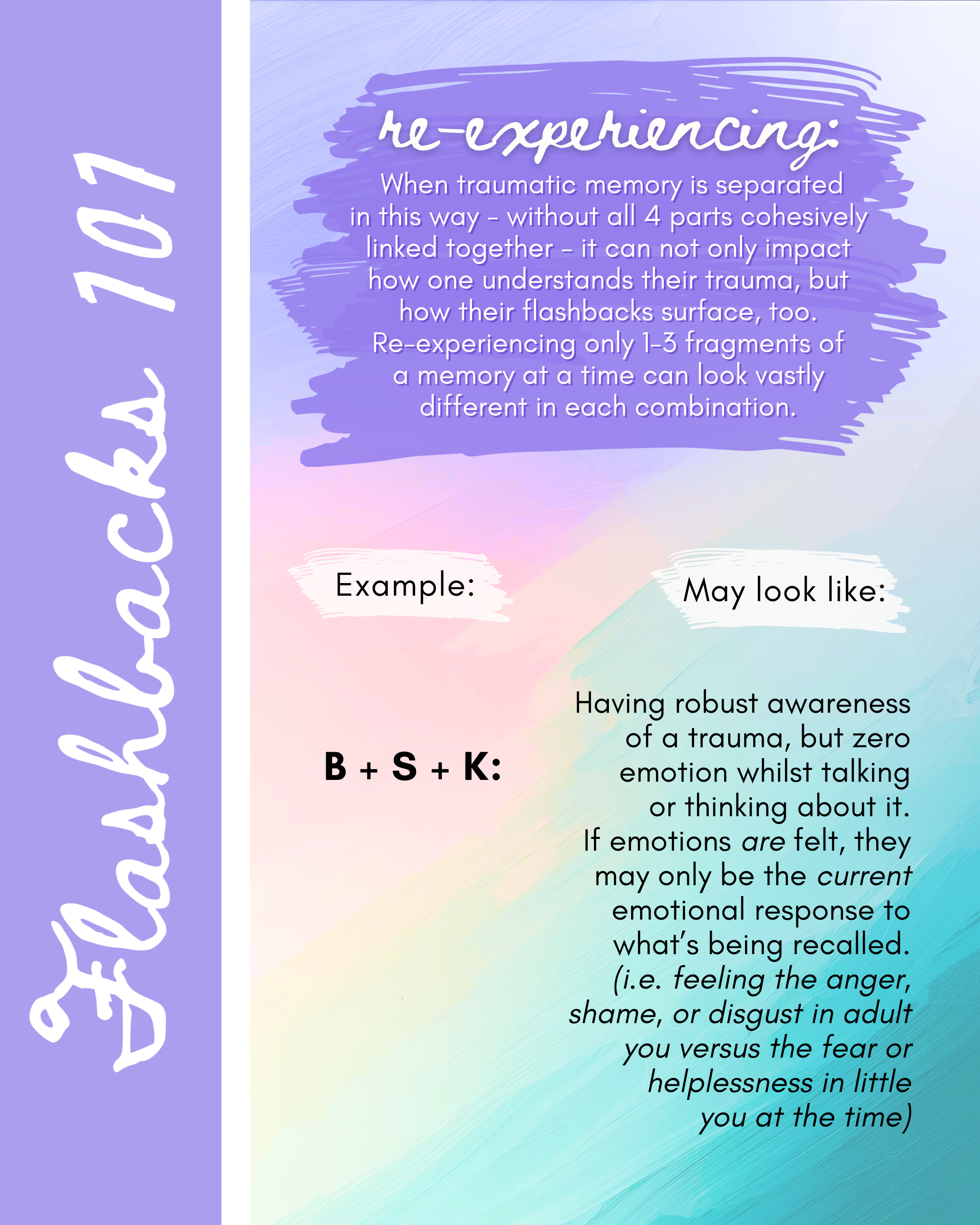
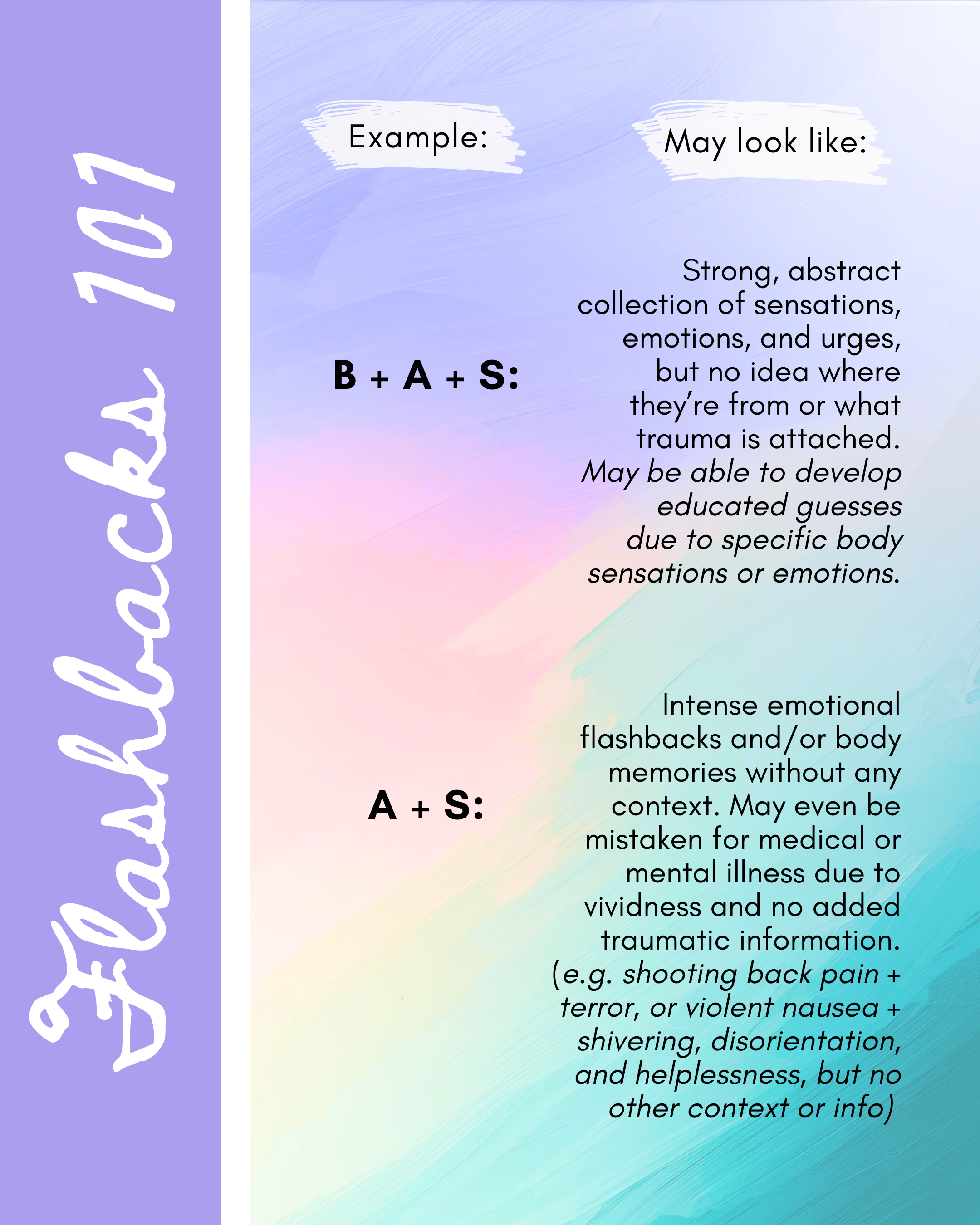
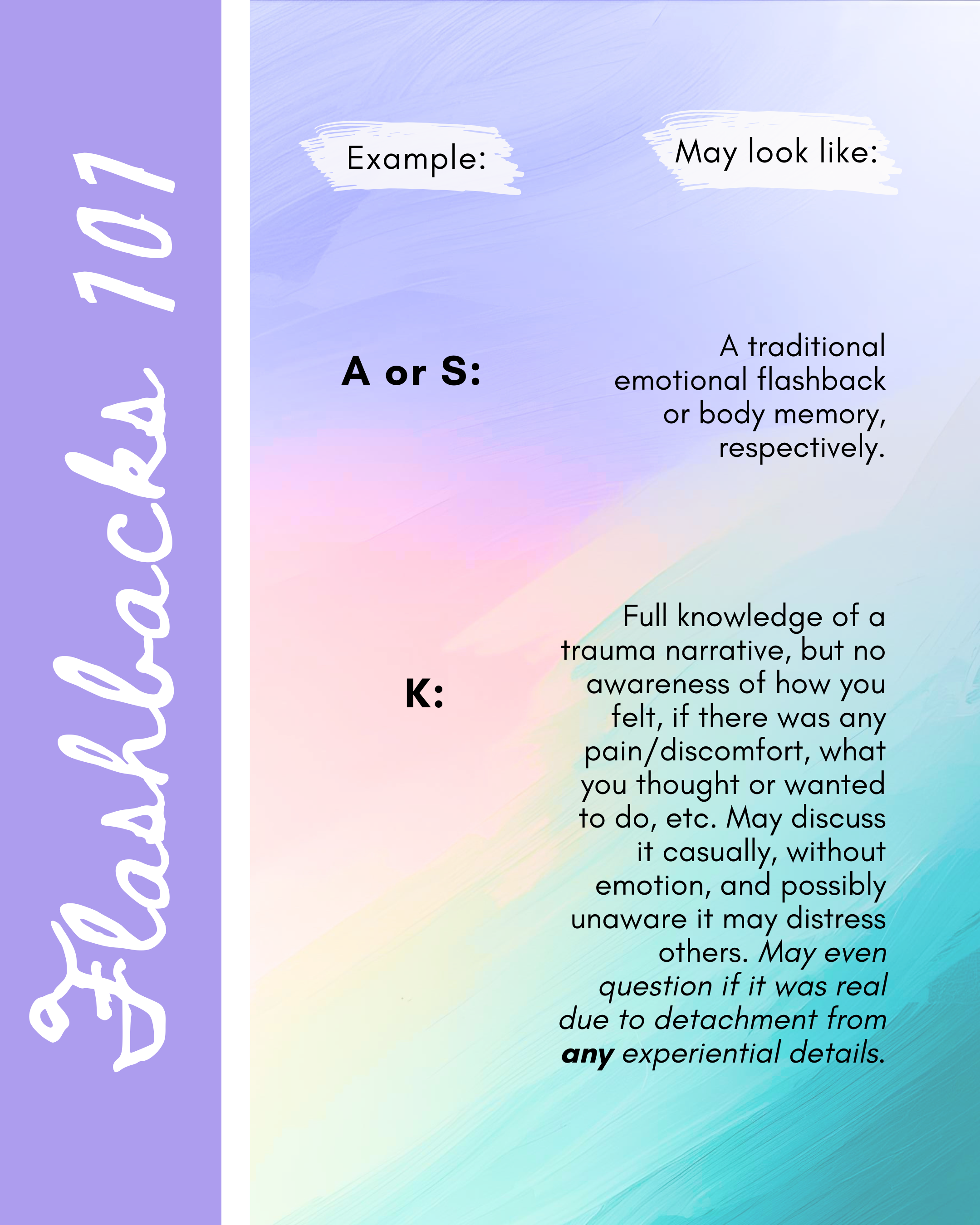
You can now understand how this can manifest in symptoms like Body Memories (S + sometimes B), Emotional Flashbacks (A), or the ability to recount your trauma to someone without a single emotion or attachment to it in the world (K without A, and sometimes no B or S, either). Conversely, you may have every single indicator of a deeply terrifying event - it’s erupting in your thoughts, your skin, your emotions - and you know a trauma has to be there by context clues alone, but you’ve got zero intellectual awareness of what it is or where it's coming from (B+A+S). These scenarios only magnify in complexity when they’re additionally scattered amongst parts of self in DID and OSDD systems.
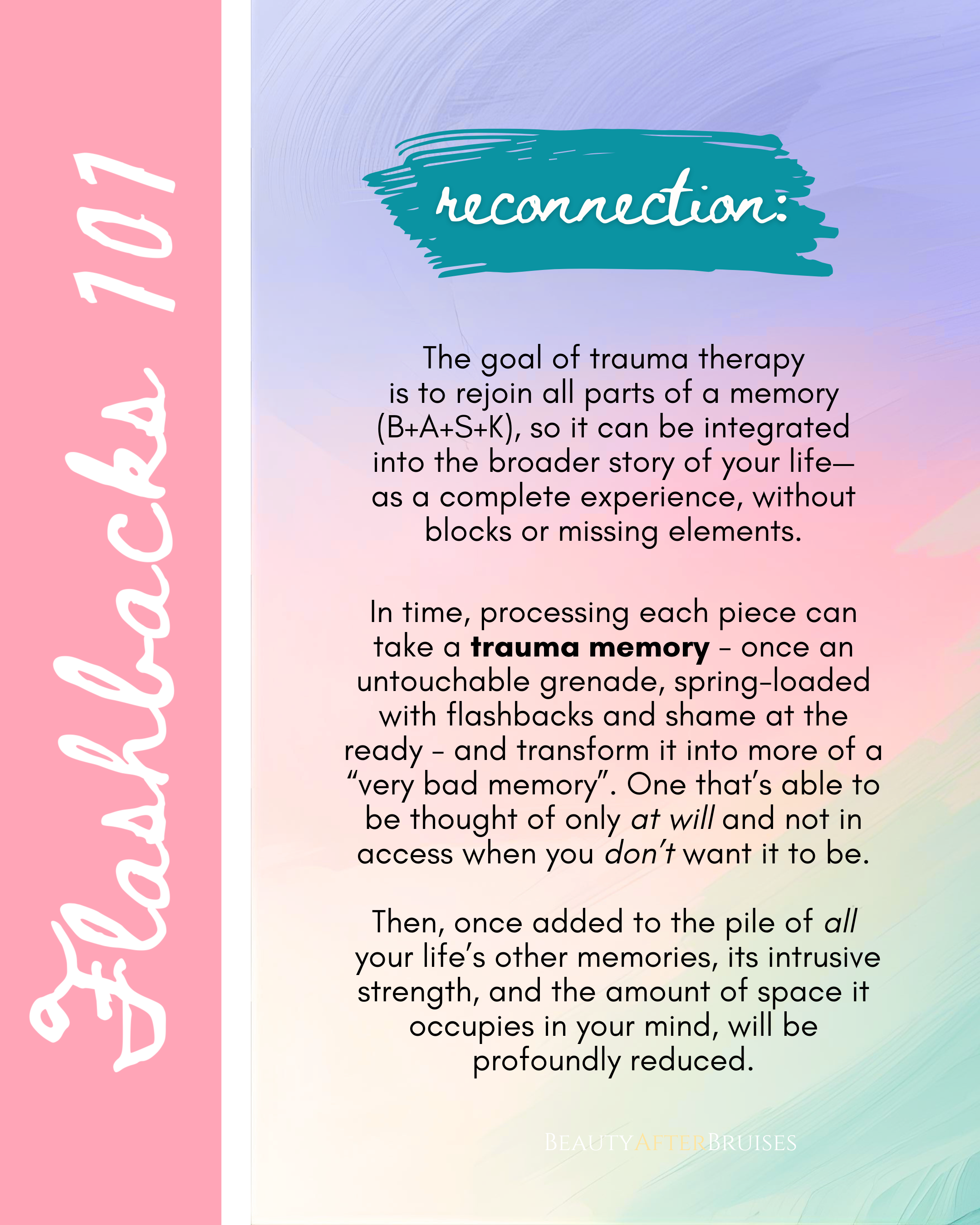
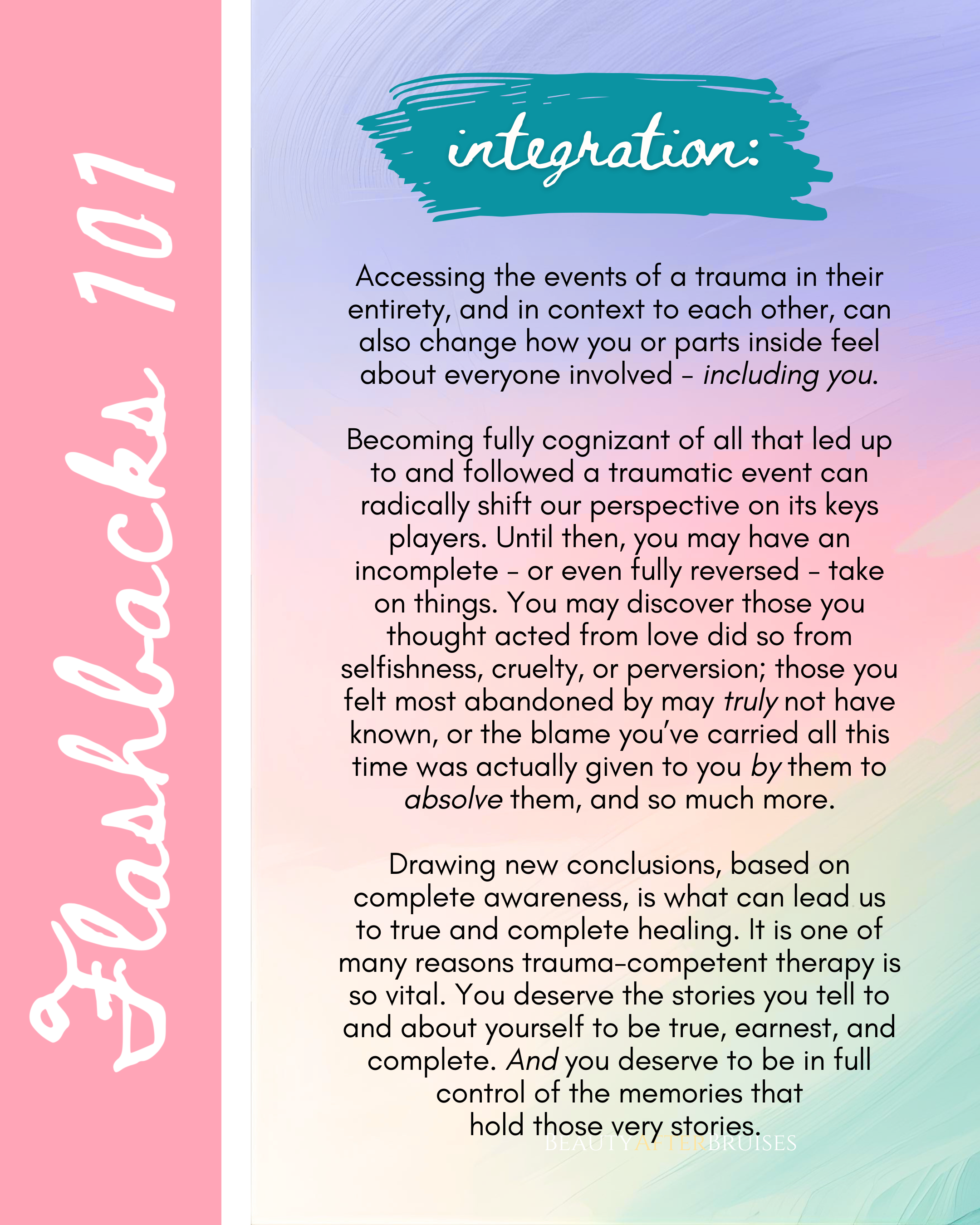
The goal of traumatic processing is to find and link - or integrate - all these pieces to one another into one full, complete memory. Then, you can further integrate them into your self-concept, your narrative, the story of your life. If you're missing any vital pieces, not only are they still likely to continue revisiting intrusively, but you may be drawing incomplete or inaccurate conclusions about the very trauma itself or what it means in the broader context of your life. You may believe a certain person in your life is much safer or more helpful to you than they really are; that you "didn't even react" when you maybe did so in very powerful ways; that you're at fault, when you unequivocally were not; that what occurred never hurt or 'wasn't that bad', when it very much did and absolutely was; that you felt fine, content, or even enjoyment, when you really felt anger, disgust, or betrayal. So much room for misunderstanding and false belief about yourself and those around you. Discovering the truth may completely reshape how you see yourself and everything around you. There is so much to be gleaned from these pieces coming together, and you deserve to know them in full, even if they're painful and difficult.
You also deserve to have control over your mind - no longer at its mercy for when it might throw these things at you or further immobilized when your guard’s at its lowest. Until then, we hope the some of the tools we’ve offered elsewhere can help to mitigate some of their effects in the meantime (such as Flashbacks 101, Healing Pool/Light, Color Breathing, or Imagery with Dials, and others). We hope all these things combined can arm you with a different kind of strength and control over your symptoms.
Let's help you take that power back! It should have always been yours!

MORE POSTS YOU MAY FIND HELPFUL:
✧ Grounding 101: 101 Grounding Techniques
✧ Distraction 101: 101 Distraction Tools
✧ Flashbacks 101: 4 Tools to Cope with Flashbacks
✧ Self-Care 101: 101 Self-Care Tools
✧ Nighttime 101 and Nighttime 201: Sleep Strategies for Complex PTSD
✧ Color Breathing 101: How to Calm Overwhelming Emotions and Physical Pain
✧ Imagery 101: Healing Pool and Healing Light
✧ DID Myths: Dispelling Common Misconceptions about Dissociative Identity Disorder
✧ Did You Know?: 8 Things We Should All Know about C-PTSD and DID
✧ Trauma and Attachment: 3-Part Series on Attachment Theory with Jade Miller
❖ Article Index ❖